


Our Education Strategy 2026-30 sets out the framework to deliver the Queensland Human Rights Commission’s education services, prevent discrimination, and strengthen human rights for all people in Queensland.
Key stakeholders for this strategy are organisations with responsibilities under the Anti-Discrimination Act 1991 and Human Rights Act 2019.
The purpose of the Education Strategy 2026–30 is to:
- set a clear vision for the Commission to prevent discrimination and build a culture of human rights in Queensland through education that is practical, evidence-based, effective, and sustainable
- embed leading practice in anti-discrimination and human rights capability to provide credible, consistent, and contemporary education that meets public, private and community sector needs
- support government, organisations, businesses, and service providers to develop, adopt, and drive leading practice
- focus on measurable outcomes using new evaluation frameworks and data integration to demonstrate the effect of education on attitudes, behaviour, and culture
- set shared guiding principles to ensure programs are trauma-informed, culturally safe, and accessible
- align our education services with the Commission’s other functions to deliver a coordinated approach
Our vision
Our vision is to deliver leading practice education services to Queensland’s duty-bearers to build knowledge, skills, capability and leadership to drive and sustain a culture of human rights and respect across organisations in Queensland, and to continuously measure and improve our impact.
The Commission’s education services aim to reduce the personal and institutional costs of discrimination and human rights limitations by strengthening fairness, accountability, and inclusion across Queensland’s workforce and areas of activity to benefit the Queensland community.
Our education model
We will implement a comprehensive education model to achieve our vision and desired impact on our target audience.
The model includes three core elements:
- PETAL guiding principles – providing core values and design standards that will underpin how the new strategy is delivered
- Four Pillars of education services –providing a separate offering or pillar of service that collectively operates as a systems approach
- Monitoring, evaluation, reporting, and learning (MERL) – providing a framework for continuous improvement.
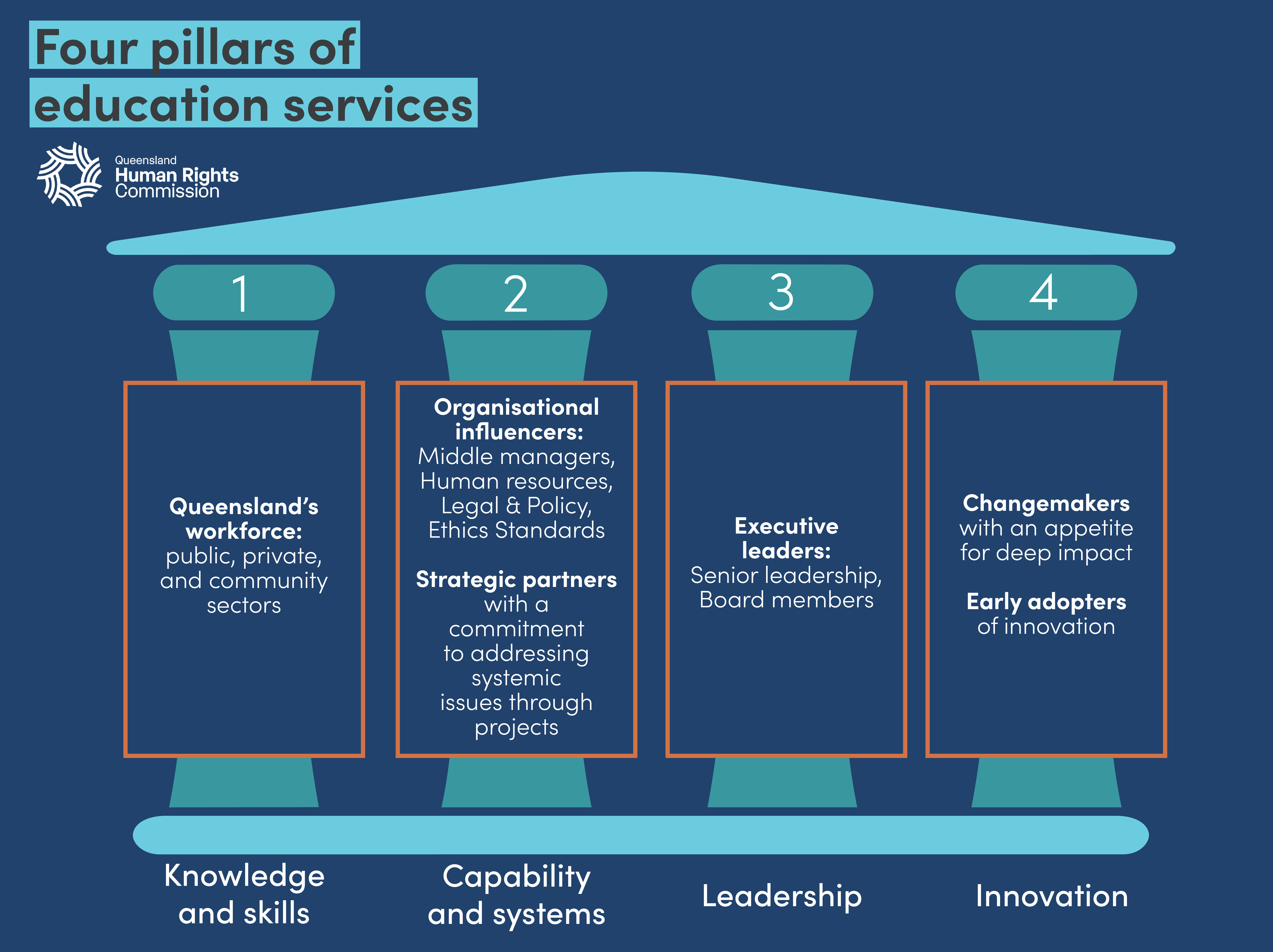
The Four pillar approach to our education services.
PETAL guiding principles
Our education services will be underpinned by a set of guiding principles (the PETAL principles) that embody the values and design standards for this 5-year strategy. These standards ensure that the Commission’s education services are rights-based, safe, inclusive, practical, and set the standard for the design, delivery, and evaluation of our education services.
The Four pillar approach defines what the Commission delivers, and the PETAL guiding principles define how education is designed, developed, experienced, and evaluated. These provide a consistent standard for quality, integrity, and accessibility across all programs, and ensure that every offering reflects the Commission’s statutory purpose and commitment to human rights.
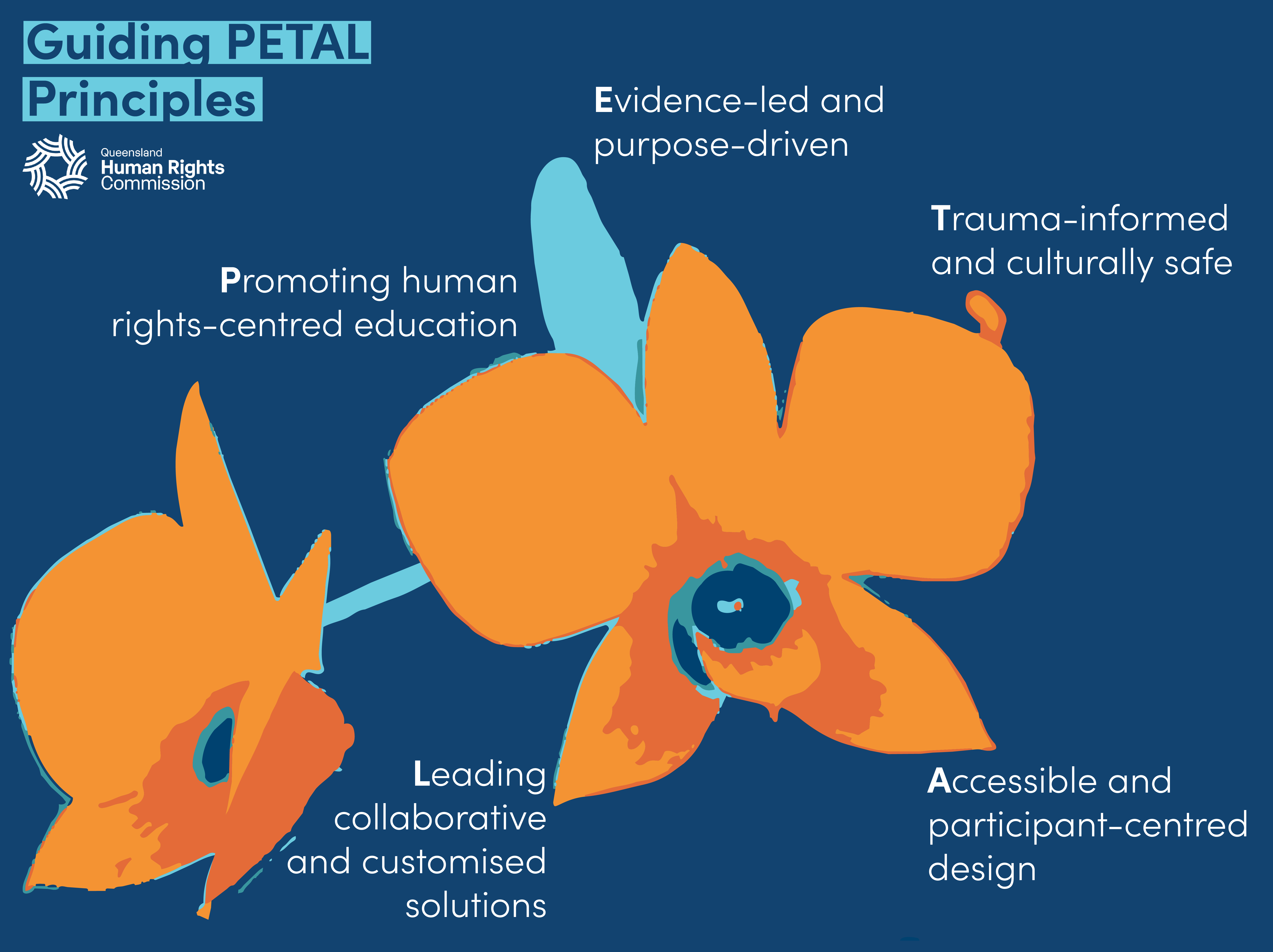
Our PETAL guiding principles.
Promoting human rights-centred education
All education will begin and end with human rights. Programs will move beyond compliance to help participants see themselves as both rights-holders and duty-bearers. This ensures that learning supports respect, fairness, and inclusion in daily decision-making and promotes a culture that values human rights across Queensland workplaces and communities.
Evidence-led and purpose-driven
Education will be designed around clear objectives and supported by evidence from research, evaluation, and practice. Programs will set measurable learning outcomes and use participant feedback and data to refine content. This ensures that every course or resource directly contributes to the Commission’s purpose of preventing discrimination and strengthening a culture of human rights.
Trauma-informed and culturally safe
Training will be delivered in ways that ensure psychological safety and recognise the impact of trauma and lived experience. Educators will model empathy and cultural humility and create environments where participants feel respected and safe to engage. The Commission will embed practices that respect cultural identity and intersectionality and ensure that education supports learning without harm.
Accessible and participant-centred design
Programs will be designed with accessibility built in. Live courses will be available through multiple delivery modes – self-paced eLearning, live workshops in-person and through virtual online platforms hybrid delivery, and sequenced blended delivery – designed to accommodate different learning styles and abilities. Plain language, universal design principles, and practical examples will ensure that education is engaging, inclusive, and useful for all participants.
Leading collaborative and customised solutions
The Commission will work with organisations and communities to co-design education that meets their real needs and contexts. Collaboration with participants, sector experts, and people with lived experience will ensure that training is relevant, authentic, and sustainable. This principle reflects the Commission’s commitment to partnership and continuous learning as the most effective path to systems-level change.
Four pillars of education services
From 2026–30, we will progressively implement our four-pillar model of education services.
Each pillar represents a distinct, but complementary, stream of work that together will enable the Commission to move from information delivery to capability development, leadership engagement, organisational consultancy, and innovation.
This model is designed to be scalable, evidence-based, and sustainable, and allow the Commission to respond flexibly to different audiences, needs, and levels of maturity across Queensland workplaces and communities.
Our four pillars are:
- Knowledge and skills: accessible, contemporary eLearning and live workshops that provide foundational understanding of discrimination and human rights laws and basic skills to apply the law.
- Capability and systems: practical, skills-based modules that develop decision-making, inclusive leadership, and policy design competence, customised for each client.
- Leadership: senior executive and board engagement to strengthen governance and accountability for rights-respecting workplaces.
- Innovation: the adoption of advanced and emerging methodologies and education technologies to deliver services with meaningful impact.